Pear-shaped captive bead ring with anodized ball, 14 ga
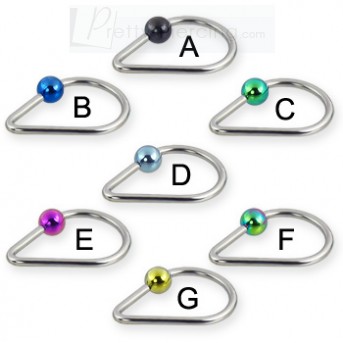
- Diameter: 1/2" (13mm)
- Gauge (Thickness): 14 (1.6mm)
- Ball size: 3/16" (5mm)
- Material: 316L surgical grade stainless steel
- Material: titanium coated 316L surgical stainless steel
- Type: captive bead ring
- -: priced and sold individually
| Click on the picture to see a big picture and description of the body jewelry you are interested in. | |||||||||
|---|---|---|---|---|---|---|---|---|---|
|
Flower cone twisted barbell, 14 ga
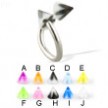
$6.40
Flower cone twisted barbell, 14 ga
Shown: 12mm twister. |
Titanium anodized triple notched industrial barbell,...
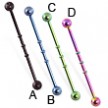
$9.99
Titanium anodized triple notched industrial barbell, 14 ga
|
Acrylic ball with stone straight barbell,...
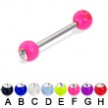
$6.99
Acrylic ball with stone straight barbell, 14 ga
Show: 14mm straight barbell with 5mm balls. |
Steel cartilage barbell with cross top,...
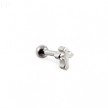
$7.99
Steel cartilage barbell with cross top, 16 ga
|
||||||
Annealing
The milling of stainless steel wire used in captive bead rings (not to be confused with bar stock that is used in barbells) work-hardens the wire to a point that it loses some of its corrosion resistance properties. It requires these properties to be considered implant grade.
Annealing is a process of heat treating metal. It involves heating steel to about one half of its melting point and cooling it in a controlled environment. Annealing stainless steel serves to produce changes in the physical condition, mechanical properties and residual stress levels of the metal. Specifically, the annealing process serves to reduce the corrosive tendencies of the work-hardened metal. During annealing, chromium carbides, which markedly decrease resistance to inter-granular corrosion, are dissolved. Annealing literally cleans up the metal.
We all know that annealed jewelry is easier to work with, and what we need to understand is that non-annealed jewelry might not be safe to use in piercings.
Catalog
Rings and Barbells
Studs & Screws
Retainers & Expanders
Type Piercing
Material
Special


